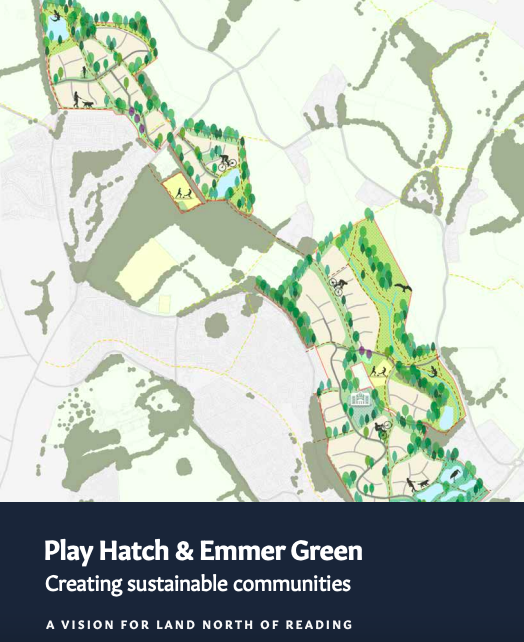
As part of the local planning process, new documents from prospective developers have been published on Reading council’s website. It appears the new materials were made available in May, so it’s with apologies that it took me so long to get round to clicking the link to “2 of 6 Regulation 19 representations F-to-K.pdf“. If you scroll down to page 81 you’ll find a sub-document submitted by Gladman entitled “Play Hatch & Emmer Green – A vision for land North of Reading”. We’d seen reference to this title before, but I think this is the first appearance of the document in the public domain.
The proposals include:
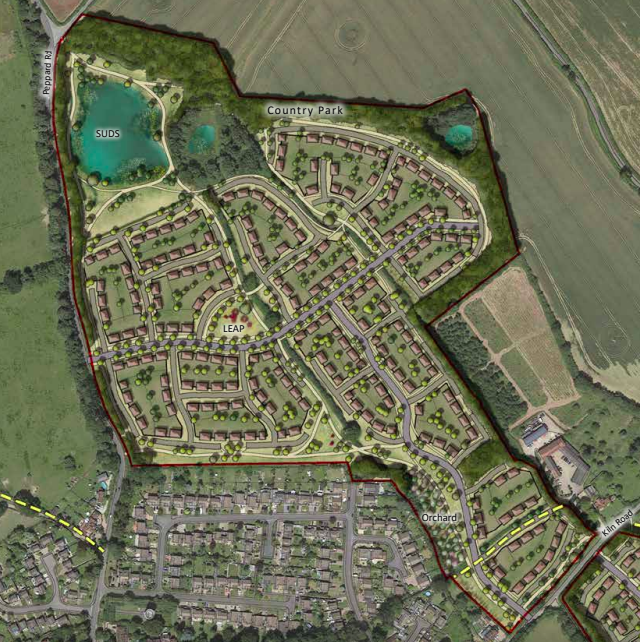
- 1200 homes including affordable, self-build and custom build
- New park & ride off Henley Road
- New primary school
- 8km new footpaths and cycle routes
- 19 hectares of new woodland
- 7 hectares of new ponds/wetlands
- Community orchard
- 3 hectares of new play areas and playing fields
- Improved facilities at Caversham Park playing fields
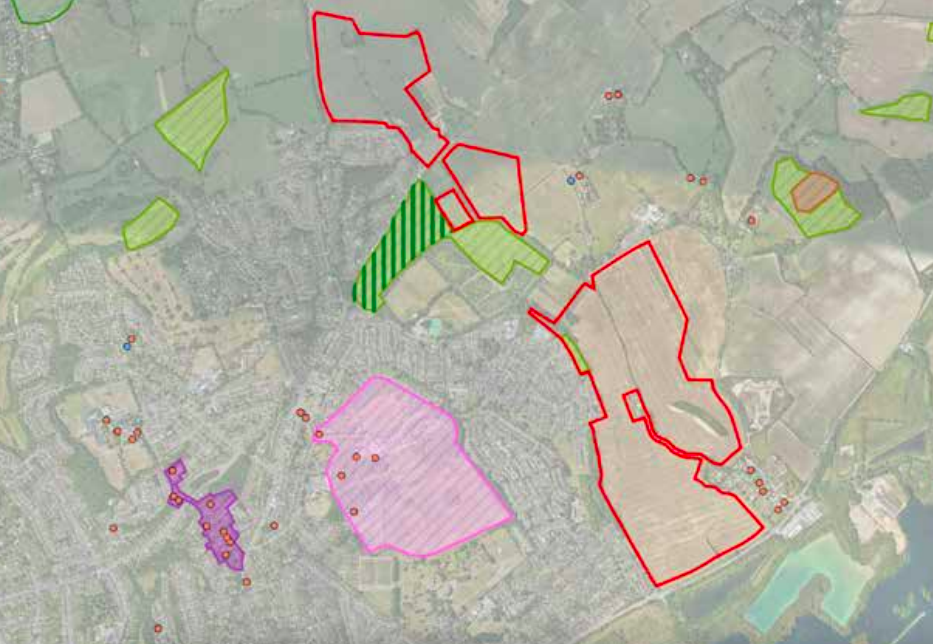
The housing would be built on two distinct areas of existing farmland. One area stretches from Henley Road at the county boundary up to the Loddon Brewery. And a second area surrounds Phillimore Road/Marchwood Avenue and Clayfield Copse. Part of the latter was the subject of a previous failed attempt by Gladman to build 245 homes nearly ten years ago.
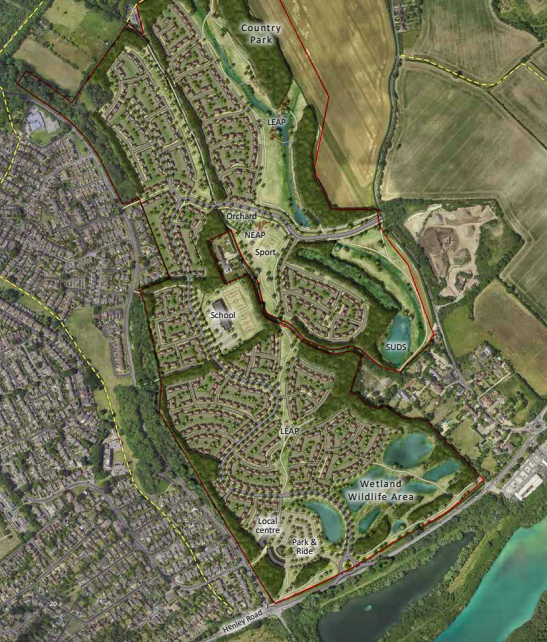
Access to the southern site would be from a new roundabout on Henley Road and also from Playhatch. Building would take place either side of Foxhill Lane, which would, I infer, be retained for non-motor traffic. The area closest to Henley Road would become lakes/ponds, to aid drainage of the wider site. A school and playing fields are shown in the middle of the estate.
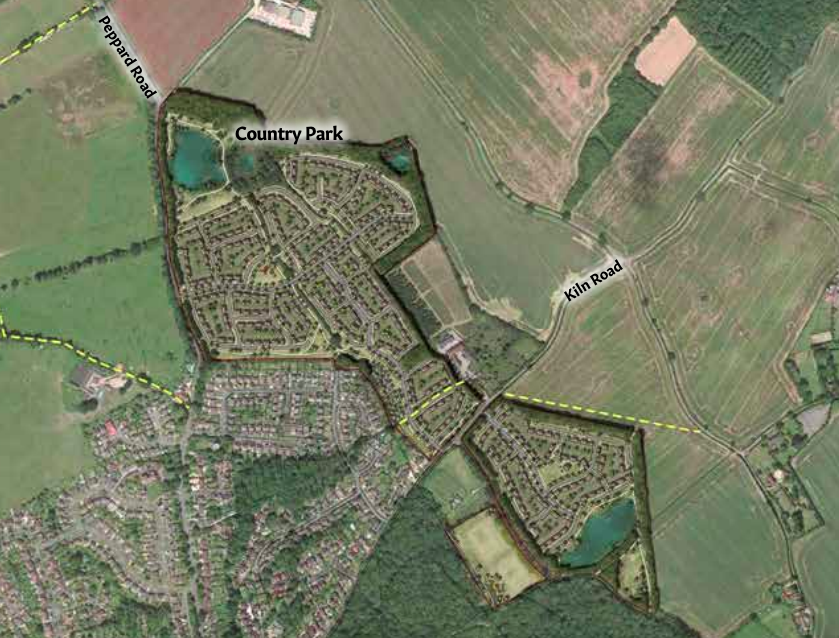
The northern site is accessed from Peppard Road and Kiln Road, with a new playing field added north of Clayfield Copse.
Those are the facts, so let’s try to interpret some of this. As I understand it, Gladman, as land promoters, are taken on by land owners at low/no cost, and then the land value uplift from winning planning consent is ultimately shared between both parties. A google search will reveal local people around the country opposing Gladman developments, and many are turned down. But presumably enough are successful for the business model to work. So much so that Gladman was purchased by Barratt for £250 million in 2022.
The document promoting the Emmer Green and Playhatch plan was written in early 2024, submitted to the council later that year, and made public in May of 2025. Potentially it’s now 18 month-old thinking, but there is more recent evidence that Gladman is still pursuing the scheme.
Two further submissions by Gladman to South Oxfordshire and Vale of White Horse (Oxfordshire) councils on their joint local plan were submitted in May 2025. Both are essentially pushing for the inclusion of their scheme in that local plan. The first document casts doubts on Reading’s ability to deliver its new housing obligation of 825 homes per year, providing evidence from the last 13 years showing an average yearly total of only 406 homes. The argument, therefore, is that unmet need from Reading needs to be provided in neighbouring authorities (as has been the case for Oxford City) and that Oxfordshire has failed to consider this need, thus invalidating their proposed plan (which doesn’t foresee development on Reading’s northern fringes). The second attempt to discredit the Oxfordshire councils is somewhat unexpected: their failure to consider the third Reading Thames bridge.
Gladman claim, “Reading and the [Oxfordshire] Councils have met 3 times since 2021 according to the Table of Engagement…” – I think I’ve been to the dentist more. “From this it does not seem that the Councils have constructively engaged with Reading on a number of strategic matters”. It goes on…
“In June 2024 Reading Borough Council produced Reading Transport Strategy 2040. The strategy
sets out transport improvements / priorities for the area, including a new crossing over the river Thames
to the east of the town”
“Despite reliance on SODC to facilitate delivery of the new crossing, there is a lack of constructive engagement… Whilst Local Plans should be deliverable, they should also be aspirational. The new crossing has been a longstanding option for relieving congestion within Reading but differing political views on its appropriateness remain, with SODC remaining sceptical. It is noted that the Councils oppose the other key infrastructure proposal…the South East Strategic Reservoir to the south-west of Abingdon, but this does feature in the Plan as a safeguarded proposal. It is unclear why the Council has considered it appropriate to safeguard land for the reservoir but not for the new crossing.”
Gladman is seemingly trying to get us a third bridge on a technicality? They go on…
“There has not been a Duty to Cooperate on the matter of bringing forward the third Thames
Crossing. Reading have clearly indicated the need for a crossing point and have reached out to
South Oxfordshire and other authorities to try to secure its delivery. Within the Table of
Engagement, there is no indication that any discussions on the matter have been had… There has been no engagement on how to deliver the crossing point, or come up with alternatives to the strategic
issue. This has been a clear failure of Duty to Cooperate.”
A new bridge is the obvious solution to Reading’s transport woes. It’s pretty much settled best practice transport design to have ring roads to disperse traffic around the edge of cities, keeping it out of the centres. This allows the arterial routes to prioritise public transport, cycling and walking, as well as improving the environment in the most densely populated area: the city centre. Reading is pretty much the largest UK inland town or city with no complete/largely complete outer ring road. The much-heralded Dutch/Belgian approaches also follow the ring road pattern, including Ghent, which is frequently brought up as a forward-looking solution that actively forces traffic out to the orbital, and back in the other side rather than even permitting cross-city motor transit.
The multi-generational third bridge saga is well documented. Oxfordshire has always opposed. More spurious arguments, such as extra traffic up to their villages have been debunked (the model showed any new demand was more than offset by Caversham residents changing habits to head south for the motorway network via the new crossing rather than winding their way up through Highmoor to the M40.) However, one key Oxfordshire argument could never be fully dismissed: that a bridge would lead to major housing developments north of the river.
And now we have firm validation of that theory. The chief third bridge campaigner now seems to be not a council or political party but a land promoter trying to get permission for 1200 houses to the immediate north of the proposed new crossing. Most people in Caversham want the bridge. Most won’t want these housing estates. Yet those outcomes seem coupled together.
Gladman underestimates their challenge of extending Reading northwards. 4000 people in Caversham objected to the golf course estate – a plan 5 times smaller than this. That opposition times five, plus the well honed bridge resistance skills of Oxfordshire will surely put paid to both ideas. And I’d expect council planning officials either side of the river to swat away these Gladman representations before local people even need to mobilise. Gladman will keep trying, and them banging heads together across county boundaries could bring some benefits. But like all before them, they’ll find that delivering a new Thames crossing proves a bridge too far, and that might sink their plans from the off.
Do share your views below – no registration required…
 Reading-on-Thames
Hi
It has been in the public domain for a while – it was submitted to SODC last year (November?) as part of Gladman’s submission on the draft SODC/VWHDC Joint Local Plan – see Response 260751922 to Joint Local Plan 2041 Publication Stage – Join the conversation – South Oxfordshire & Vale of White Horse – Citizen Spacehttps://theconversation.southandvale.gov.uk/policy-and-programmes/jlp_publication_stage/consultation/view_respondent?_b_index=420&uuId=260751922 and it’s Appendix 3 of Attachment 2.
Thanks for your interesting analysis of the relationship to the third Thames crossing.
HS
LikeLiked by 1 person
Thanks! So it is … page 122, appendix 3, attachment 2. However did I miss it!!
LikeLiked by 1 person
One way it can work is that the Developer or Promoter will pay the landowner an up front amount for an option to acquire the land at a discount to market value (subject to a level of planning permission being achieved). The promoter/developer then takes on all of the risks and rewards of the planning process.
LikeLiked by 2 people
This plan is idiotic and should fail at the first hurdle for at least 3 reasons. It’s not that it’s protecting green and pleasant lands, that’s industrially farmed fields, those are nice to look at but fundamentally not great for biodiversity or particularly helpful for nature. There’s greenwashing as part of the proposal, but that’s all it is.
Build density in central Caversham and/or emmer green instead. Build up, not out. Done properly (e.g. with requirements for family sized apartments that are 150m2+), that creates dense communities that are cheaper to maintain, well served by public transport, with the walkable neighbourhoods that can support restaurants, pubs, community centres and bolster existing businesses.
RBC will end up footing the bill for that infrastructure long term, road repairs, more inefficient bus routes, lighting, traffic mitigation, policing, etc… Meanwhile the developers and land owners get to make hundreds of millions in profit for a simple rule change.
LikeLiked by 1 person
Where in the existing settlement areas of Caversham or Emmer Green could higher density housing be acommodated? Do you envisage demolishing some streets of existing housing to achieve this, or is there some other brownfield site I’ve missed?
LikeLiked by 1 person
[…] Gladman proposes 1200-home Caversham extension […]
LikeLike
The game is up with developers! You cannot disguise overdevelopment with nice phases like adding parks, wetlands and community orchards, cycle and pathways. These are all good buzz words, alongside the often so called overused offer of more affordable housing.
This is just another housing estate with little or no service provision, and will have additional pressure on already overstretched water resources and road systems. If such large scale developments are allowed to go ahead, then Caversham will be cut off from the open countryside and the settlements of South Oxfordshire will just become another suburb of Reading.
LikeLiked by 1 person
absolute madness, we must do all we can to make sure it fails.
LikeLike
Why are we adding a primary school there when the two schools across the road in Caversham park are already practically empty?!?! And where do these families end up for secondary when the local schools are already oversubscribed?!
So many issues with building more housing in this area – drainage system that already can’t cope, roads are awful, traffic and bridge problems will just get worse. Services that already can’t cope such as the NHS, hospital in Reading, doctors etc. Buses have already been cut back so how will people get around?! Such a bad idea all round!!
LikeLiked by 1 person
At the risk of presenting an unpopular opinion, this proposal seems pretty sensible. The road network in the area is reasonable, providing a route into the greater Reading area relatively easily and also out into the rest of Oxfordshire. As flagged, it could be made better with a nearer and more direct third Thames crossing, and maybe this development would add weight to that argument.
The provision of a school, playing fields, and green areas seems fair. I take the comment about nearby primary schools, but extra capacity is rarely a bad thing. The two existing pubs and the Lodden brewery may even welcome the proposals and provide the new locals a place to venture too.
Opposition will I’m sure be strong, as demonstrated above. Arguments for greater density housing are not really within the character of Caversham, and I would imagine probably not aligned with everyone’s aspirations of home ownership. If higher density housing is your thing, well Reading town centre is delivering that in spades already.
Realistically this country needs more housing and a variety of types of housing. Ultimately it has to go somewhere and unfortunately at times that will mean the loss of green space. Arguably placing this at the margins of already existing settlements makes the most sense. I agree that does mean that car usage will be ‘hard-coded’ into prospective residents behavior, but in 2025 that is how the majority of the western world works. We’d need a monumental shift in culture to change that, and with the best will in the world I don’t see that coming anytime soon.
LikeLiked by 1 person
The local road connections to Reading are not ok, Caversham is a congested mess. People living in this development would have to have cars. Building more car dependent suburbia is generally a bad idea. Central caversham is already pretty dense and can easily increase density without major negative consequences.
More housing doesn’t have to mean loss of green space, especially if we bias away from car dependent suburbs that take up enormous amounts of space, create atomised communities.
That change is happening, the area between the train tracks and the river used to have only a few hundred people living in it, mostly Caversham Borders. in the next few years, it’ll be home to about 3-4,000 people should the majority of the proposals for the likes of the Station Retail Park get completed, with almost none of those new inhabitants having a car. It will drive a stronger active travel culture in the town, better usage of public transport and a far more sustainable pattern of housing growth.
The council are to be lauded for supporting, this despite the very vocal and obnoxious opposition in the press and social media.
LikeLiked by 1 person
the dinghy people say yes please.
LikeLike
I’d have thought/hoped that a site like this would have received a higher standard of comment than yours – a barely Chronicle-level of BTL quality!
LikeLike
Sounds quite logical ansd emphasizes the need for a third bridge . Where do the nimbo’s think Cav Park Village evolved from?
LikeLiked by 1 person
no mention of health centres
LikeLiked by 1 person
There is no mention of health centres or Doctor facilities
LikeLiked by 1 person
What about Doctors and Dentist, all in Sonning Common and Emmer Green are at full capacity, and what about sewerage, water etc
LikeLiked by 1 person
Despite (because of) living on Henley Road for many years I have never understood the argument for a third bridge. There just isn’t that much traffic from east Caversham/Henley. We can be assured that if another bridge was to be built there would be: induced traffic. That’s not good.
Regards the plans to extend Caversham eastwards; well, I spent years roaming those fields and would be sad to see them go. But Caversham Park Village is actually a really nice development (on land my dad played in as a child!); something of equal quality would be a good use of the land.
What would be good would be to upgrade the cycle markings on Henley Road to a proper LTN 1/20 standard cycle track and extend it down Star Road on to Gosbrook Road to reach Hills Meadow and our actual third bridge, the Hills Meadow bridge. Station Hill needs rebuilding to allow people riding bikes to get to Station Road from the underpass too.
LikeLike
I must admit that when I visit my dad I use a bike to either to go into Caversham or into town, so I don’t experience the congestion that people who use cars do.
LikeLiked by 1 person